
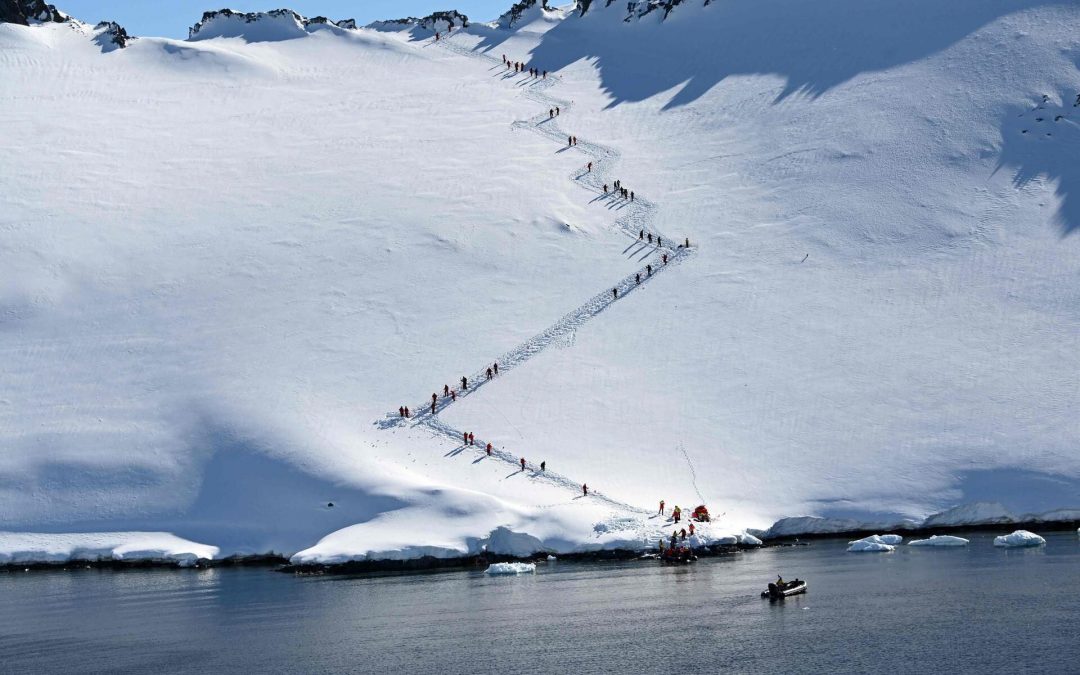
Last year, for the first time, more than 100,000 tourists visited Antarctica. That figure is expected to increase in 2024.
It is in stark contrast to visitor numbers during the global pandemic when only two ships and 15 people ventured to the southern wilderness in the name of tourism.
Leslie Hsu, a freelance journalist and award-winning photographer, understands why. She had one of her most memorable holidays in the region.
She recounts a story of camping on the Kerr Point of Ronge Island, where she could hear the iceberg-laden waters of the Errera Channel lapping against the shore.
“I make my way towards the shoreline until I can hear waves striking rocks,” she tells The National. “Turning off my headlamp, I am engulfed in darkness, barely able to see my fingers in front of my face. At first, I feel exposed, vulnerable – unusual for someone who grew up camping, hiking, spelunking, climbing mountains and crossing rivers. Someone who came to Antarctica precisely to be alone with the coldest, driest, windiest, most hostile place on Earth.
“A series of glaciers calving, one after another like dominoes, ripples towards me. I feel the ground trembling. Water rushes towards me and I cringe, expecting to be swept away into the channel. After things settle down, I sit down on the soft snow. Surprisingly, I don’t feel cold at all, cosy in my wind and water-resistant parka and boots. I doze. I listen. I breathe. Out of the darkness, blacks brighten to greys. There is no sunrise, just a gradual increase in contrast.
“I hear a whale surface for air. Kelp gulls tweet a morning greeting. And just when I start to worry that maybe I shouldn’t be sitting out here by myself, I see six Gentoo Penguins take form not a stone’s throw away. They are all sleeping with their necks tucked into their backs, perfectly camouflaged in the austere black and white landscape.”
It’s precisely this type of once-in-a-lifetime experience that has so many travellers flocking to Antarctica.
Unique journeys across the White Continent
This polar region is roughly twice the size of Australia and 98 per cent covered in ice. It is the largest wilderness on Earth unaffected by large-scale human activities and, as the only continent without an indigenous population, it is also one of the most protected places on the planet.
Winter in Antarctica is from March until October, and when daylight hours disappear, temperatures plunge to minus 30-60°C and the physically remote destination becomes even more inhospitable. But by autumn, as the country’s unique wildlife begins to emerge from hibernation, so too do the zealous tourists.
Antarctica is also the only continent with no terrestrial mammals, but it does have millions of penguins, thousands of seals and eight different species of whale. The allure of seeing these creatures in the wild is one of the main reasons people keep coming to the remote land.
Google data comparing search traffic from 2019 to 2022 showed a 51 per cent rise in interest around Antarctica cruises, and a 47 per cent rise in interest for Arctic cruises. Other trips are on the rise, too. These include luxury travel company Black Tomato’s nine-night Antarctic adventure that sailed to the White Continent at the same time the region witnessed a rare solar phenomenon. Or Elite Expeditions’ new voyage that will see travellers conquer the glacial beauty of Antarctica’s Vinson Massif.
While the pause in tourism during the pandemic allowed wildlife to thrive, the International Association of Antarctica Tour Operators estimates that 106,000 visitors travelled to the region in the 2022-2023 tourist season, meaning those who work to protect the White Continent and its environment are wary of this increasing interest.
A wilderness that belongs to no nation
Seven countries – New Zealand, Australia, France, Norway, the UK, Chile, and Argentina – have all laid claim to different parts of Antarctica, but the destination is governed by an international partnership to which more than 56 countries have acceded, making it a wilderness that belongs to no nation.
Its tourism board is also unique. In 1991, the International Association of Antarctica Tour Operators (IAATO) was set up not to encourage more visitors, but to regulate the sector and ensure the pristine environment remains so. Since 2009, concerns about the impact of tourism on the environment have been a recurring hot topic at the continent’s annual Antarctic Treaty Consultative Meeting.
Several measures are already in place. As most visitors venture to the seventh continent via ship, better practices have been adopted to reduce the carbon footprint and environmental impact of any cruises sailing in these waters. There are also restrictions on how many people are allowed ashore, and strict regulations for planned activities, wildlife watching, and pre and post-visit activity reporting.
These rules are carefully followed by Black Tomato on all of its voyages. “We demand the highest standards from our partners, in everything from sustainability to safety, creativity to delivery,” says Tom Marchant, co-founder of the luxury tour operator. “In Antarctica, those standards mean we only work with a small selection of hand-picked IAATO-approved operators, and have seen us advocate light-touch, small-scale experiences where we can be assured that guidelines are being followed.”