
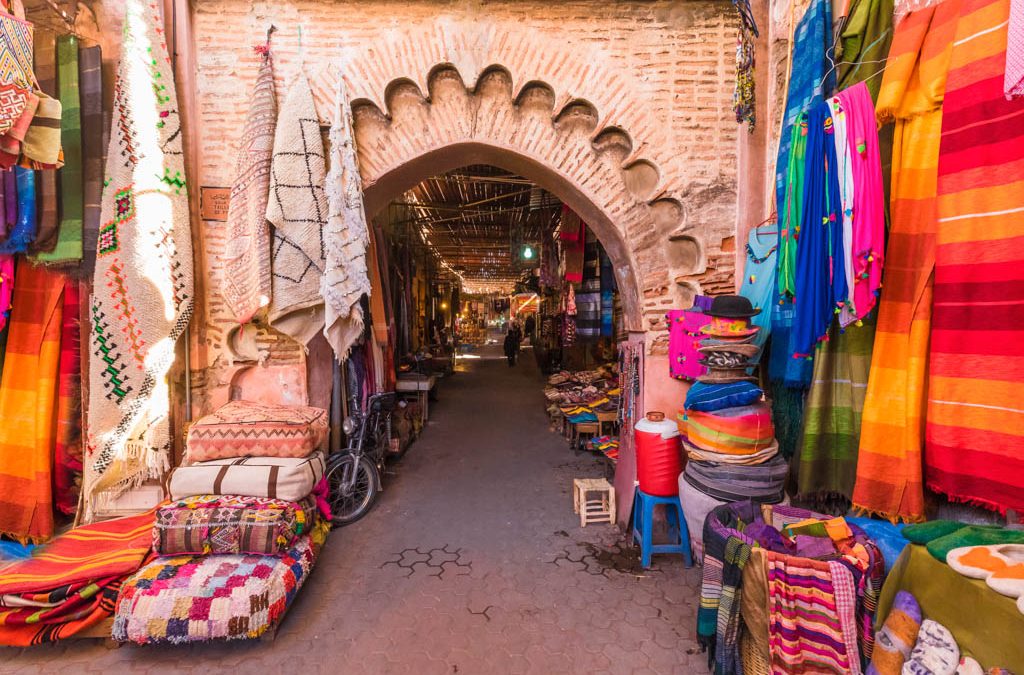
s I walk through the dimly lit narrow lanes that crisscross the labyrinthine 11th-century Medina of Marrakesh, I could be travelling back in time. This bustling medieval Moroccan metropolis was once one of North Africa’s main commercial hubs.
I pass metal workers delicately engraving complex patterns on copper lamps and teapots; aged artisans expertly stitching exotic babouche slippers; and a teenage apprentice belt-maker hammering supple leather that has come straight from the open-air tannery. Elsewhere, rug and textile weavers work to a rhythmic beat on wooden handlooms, inventing intricate patterns with colourful strands of silk and cotton, while dyers plunge thick cords of wool into bubbling multi-coloured cauldrons before theatrically hanging them from the roof to dry.
Here in the medina, genuine artisan skills are miraculously thriving, centuries-old traditions proudly maintained and passed on from generation to generation. While in many countries, high-quality, hand-crafted creations are increasingly threatened by mass-produced alternatives from factories in China and India or cheap fakes that copy everything from Murano glass to Lacoste T-shirts and Louis Vuitton handbags, the artisans of Marrakesh have discovered how to survive.
Their livelihood is guaranteed today quite simply by sustainable tourism; the daily flood of visitors streaming into the medina, ready to spend Moroccan dirhams on some of the world’s finest arts and crafts. And that constant demand has neither disappeared after the long Covid lockdown nor diminished following the recent earthquake that rocked, but fortunately did not seriously damage, the medina.
I begin by exploring Souk Semmarine, for centuries the main entrance into the medina’s maze where everyone plunges in from the chaotic Jemaa al-Fna square. Walking past stalls selling all manner of olives, fragrant spices and irresistible sticky sweets, I enter the opulent Palais de la Menara, where the family of Mustapha Zidane have been showcasing their handicrafts for 85 years.
As Zidane points out delicately carved furniture, vivid rugs, ornate mirrors and lamps, he tells me they work with an atelier of 50 artisans, alongside independent specialist craftsmen who have collaborated with the family for several generations. They specialise in one-off, made-to-order pieces and their main customers are foreign visitors.
“We have no problem selling our merchandise today,” he tells me. “But we have to work hard to motivate the next generation of artisans to continue the traditions of their fathers. That means starting at 10 or 11 years of age and convincing them to concentrate on crafts like pottery, carpentry, metal work and painting, rather than their mobile phones and video games.”
Specialist souqs branch out from Semmarine. I suddenly find myself surrounded by scores of stores selling shoes, leather bags and belts. In the exotic Maison des Babouches, a hole-in-the-wall Aladdin’s cave, Aziz Souri pours me a scalding glass of mint tea while explaining how they make everything in leather, from bags to pouffes and shoes to traditional babouche slippers.
“Traditionally, Marrakshi artisans prefer to work undisturbed at home, and what is changing today is that instead of having their house and atelier here in the medina, many are moving out of the historical centre.”
Souri believes that the faithful local clientele will ensure that medina craftsmanship will always exist, but the extra money from tourists allows them to enjoy a better lifestyle.
Craftspeople here are becoming increasingly sophisticated both in following international design trends and in using online sales methods to reach a global audience. Tour guide Younes Ajana has seen a big difference since the enforced Covid lockdown.
“Artisans were forced to stay at home and discovered that e-commerce lets them reach out to huge new potential markets rather than sitting in a cramped souq stall waiting all day for a tourist to pass by and bargain over the price of a pair of babouches,” he says.
I wander towards the edge of the medina into the more popular neighbourhoods of Bag Taghazout and El Moukef, where locals choose the freshest sardines and shark steaks from pavement fishmongers, haggle with butchers and select aromatic bunches of fresh mint, parsley and coriander. Tourists today are becoming more adventurous and discovering daily life in these backstreets, and their presence is changing the attitudes of some young artisans.
Not far from the 16th-century Medersa Ben Youssef – an Islamic school – Ayoub Banouna starts weaving his graphic wool and cotton scarves in the early morning behind his loom and is still weaving come 8pm.