
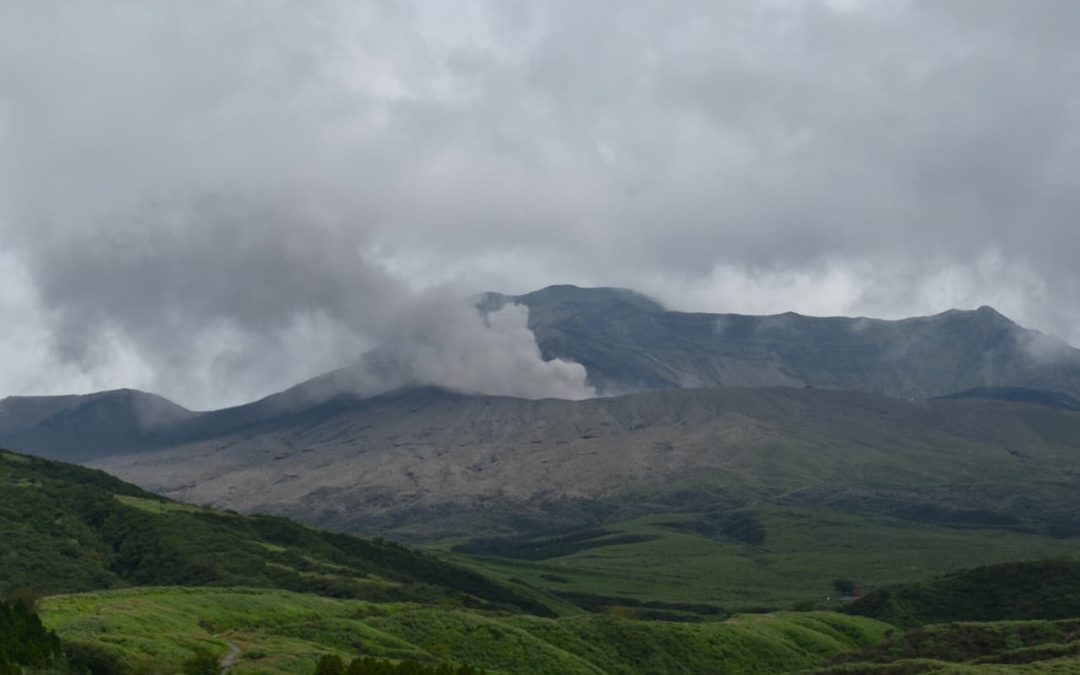
Dominated by the brooding presence of Mount Aso, the heart of Kyushu – Japan’s most southerly main island – has been forged from fire and water. Those same elements continue to shape it to this day.
The largest active volcano in Japan, Mount Aso may not have the perfectly symmetrical cone that has made Mount Fuji a symbol of the nation, but the unique environments that surround the peak have turned it into the perfect place for anyone keen to explore the country’s great outdoors.
Only 35 kilometres east of the recently refurbished Aso Kumamoto Airport, the volcano is the centrepiece of the Aso-Kuju National Park and is made up of five distinct peaks that have emerged in the middle of a caldera that is 25km across, making it one of the largest in the world. At 1,592 metres, Mount Taka is the highest of the five peaks, but Mount Naka is the most accessible and, at present, the most active. And that makes it a good place to start any visit.
From the completely flat base of the caldera, the road begins to rise through a series of curves flanked by a sea of undulating grasslands that are grazed by the local “aka ushi”, or red cows, named after their colouring. Wisps of cloud come and go as we climb higher until the greenery finally peters out and we are driving across a lunarscape.
The crater of Mount Taka is a deep gash in the earth that emits clouds of superheated steam. In the very bottom, the pools of cloudy water are green-yellow. Sulphur hangs heavy in the air.
The most northerly of the peak’s craters last erupted as recently as October 2021, releasing a towering column of ash thousands of metres into the sky. The threat is taken seriously, with sturdily-built concrete shelters almost on the rim and the road up to the crater closed at the first hint of subterranean rumblings.
Hiking trails criss-cross the surrounding area, which were in centuries past dotted with temples and shrines dedicated to the gods of these violent mountains. Eruptions, earthquakes and lava flows eventually convinced the monks to move their places of worship further away, although the occasional stone monument can still be spotted amid the rolling landscape.
Mount Aso’s grasslands are critical to the local ecosystem, providing a home for countless species of flora and fauna, and helping to retain water, while the grass itself is an important resource. Every spring, local volunteers carry out a closely-controlled burn of the grass to allow the new growth to come through the fertile soil in a matter of weeks.
Dusty and with the volcano’s unmissable scent clinging, we take the road back down the mountain, traverse the paddy fields and switchback up the steep northern side of the caldera until we reach Hoshino Resorts Kai Aso. The only luxury-grade hotel in the region, the resort is made up of a dozen individual cottages set amid a lush hillside forest.