
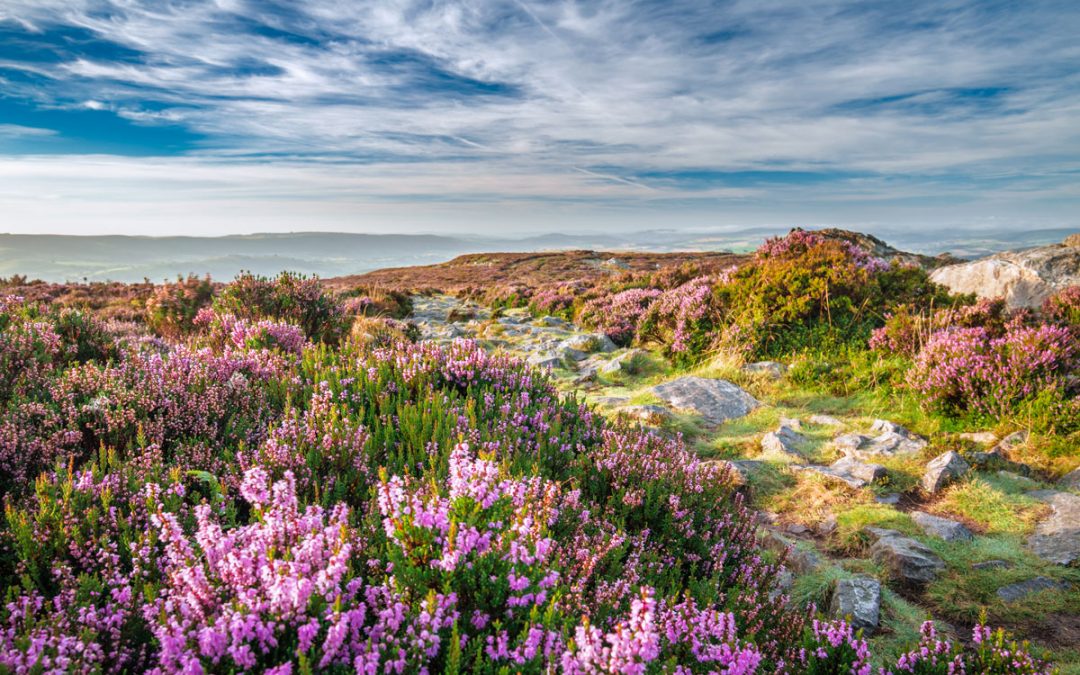
In the shadow of Belstone Tor – a distinctive hill topped by granite rock formations – standing stones formed a circle in the cropped grass. Some say the stones were once maidens, petrified into rocks for dancing on the sabbath; others warn that to move the stones is to welcome a curse. In reality, the “Nine Maidens” mark a Bronze Age burial chamber, one of the countless ancient sites hidden across Dartmoor National Park’s 368sq miles of moorland, valleys and forests.
I hiked a faded path etched into the ground over millennia, picking my way through piles of granite boulders to the summit of Belstone Tor, 479m above sea level. In a country where there’s no right to roam across 92% of the countryside, the open moorland I saw stretching south – devoid of field boundaries and fences – has long provided a natural escape for outdoor enthusiasts.
For decades, Dartmoor National Park – located in the south-western county of Devon – was the only place in England where “backpack camping” (wild camping without needing to ask the permission of the landowner) was legal, but a controversial High Court decision made in January 2023 threatened to outlaw this tradition. This sparked a nationwide debate on public access in the English countryside, with hikers, mountain bikers, nature lovers, climbers and horse riders rallying on the moors to protest. In July, the momentous decision was overturned and backpack camping once again became legal in the national park.
“Southern England has very few big spaces and fewer where one could actually get lost. People are drawn to that, and the combination of tors, ponies, steep valleys and miles of undulating moorland is instantly recognisable,” said Inga Page, as she explained the attraction of Dartmoor National Park. “There’s also the dark side – the bogs, the fog, the prison – which makes it so much more than just a pretty landscape.”
A lifelong walker and environmental activist, Page quit her job in 2012 to spend the last decade leading walks on Dartmoor after founding the tour company Dartmoor Walks This Way. Like many people before her, Page was captivated by the stark natural and human history of the moors.
The great granite tors (65% of Dartmoor is granite), which look like they were stacked by giants, began forming some 280 million years ago, while the oldest cairns, menhirs, stone circles and burial sites were raised by Dartmoor’s earliest human inhabitants as early as 3500 BCE. Legends, superstitions and folk stories – like those of the beast-like “Wisht Hounds” that stalk the moors, or the “Hairy Hands” that steer unsuspecting drivers to their deaths – abound on Dartmoor, while the seemingly bleak landscape is, in fact, filled with rare species of flora and fauna, including surprising pockets of temperate rainforests that hikers might chance upon.
Designated as a national park in 1951, Dartmoor is the remnant of a medieval “commons” system once found all over England that gave commoners (landless people of non-noble standing) certain rights of access over “common land”, which was public land where they could graze livestock or collect wood for fires and cooking. From the 16th Century onwards, much of this common land – and the rights of access that went with it – was closed off, as private landowners began enclosing it for private agriculture.
Unusually for England, up to 37% of Dartmoor National Park (and 75% of the park’s upland moors) is still considered to be common land, although all of that land is still privately owned. Kelly Rich, the communications lead for the Dartmoor Preservation Association, an organisation that has been protecting Dartmoor since 1883, explained how these historical common rights led to the national park’s liberal recreational rights, including the freedom to roam when hiking, horse riding, biking and rock climbing.
“The 1985 Dartmoor Commons Act was a framework that enshrined both commoners’ rights and recreational rights,” she said. “And recreational rights were hard fought at the time to be included.”
It was always assumed that backpack camping – which allowed for individuals and small groups to spend one or two nights on remote moorland within designated areas of the park, so long as all their gear was carried in a backpack – was one of these recreational rights, and certain areas of Dartmoor had traditionally been designated as backpack camping zones.