
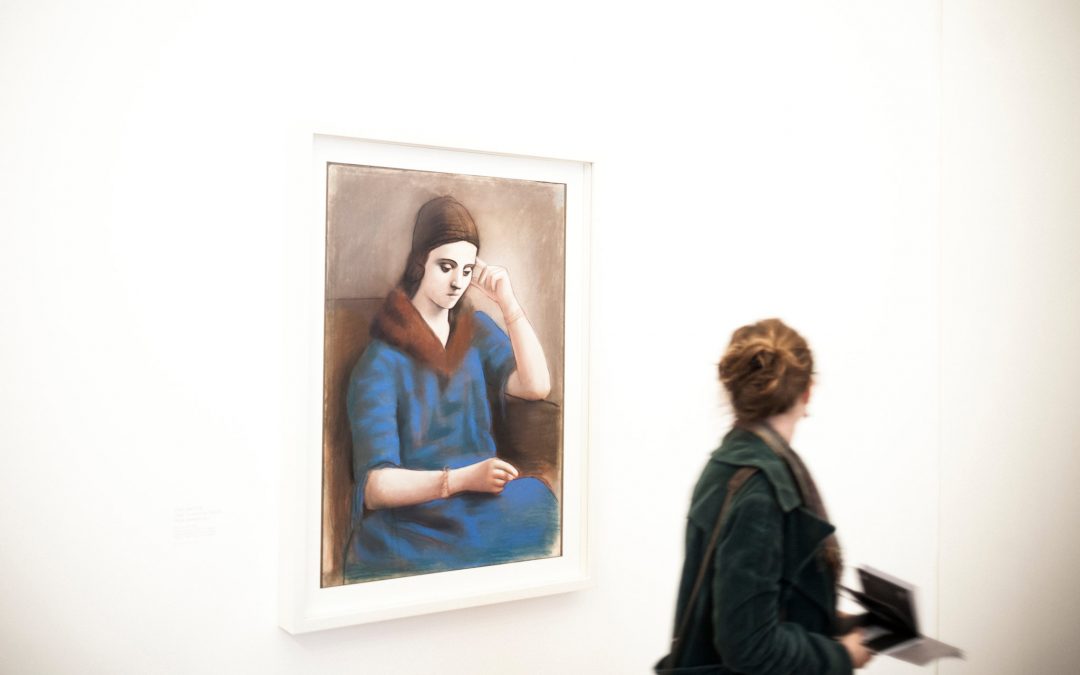
The museum, also known as Musée Picasso Paris, boasts that it is the only institution that can trace Picasso’s development from the very beginning up to his death in 1973.
A section called “Laboratory” highlights Picasso’s countless sculptures – made from cardboard, metal, wood, cigar boxes, and whatever else came to hand – together with related drawings and paintings.
Another focuses on his work during World War II and the Nazi occupation of Paris, including the sculpture “Man with a Sheep”, which became a symbol of resistance.
‘Unhinged side’
One room has been entirely dedicated to Gilot, who died in June 2023 at the age of 101. She lived with Picasso for a decade up to 1953 and had two children with him.
Gilot is seen as the one long-term partner who managed to stand up to his often tyrannical behaviour towards women, establishing herself as an artist in her own right. Her works are on display at the Metropolitan Museum of Art and MoMA in New York.
It was Gilot’s 1965 book, “Living with Picasso”, that first introduced the public to the more unhinged and selfish sides of the great painter’s character.
But she recalled their relationship without rancour in an interview with AFP in 2016, continuing to praise his “remarkable intelligence” and sense of humour.
With many of Picasso’s works travelling around the world for the 50th anniversary of his death last year, the rehanging is billed as “his return home”, said museum director Cecile Debray.
It contrasts his work with artists who influenced him, including Henri Matisse and Paul Cezanne, as well as many anonymous sculptures from Africa and Oceania that ended up in his collection.